

It is 1942, a month after the attack on Pearl Harbor, and America is at war. As the country enters this new chapter in its history, one thing remains unchanged: the undisputed heavyweight champion of the world is Joe Louis. Since winning the title in 1937, “The Brown Bomber” is clearly the most dominant heavyweight king since Jack Dempsey, so much better than everyone else that no serious challengers for his title remain. But Louis has a little unfinished business with Jacob “Buddy” Baer, younger brother of former world champion Max Baer and, at almost 6’7″ and over 240 pounds, one of the biggest men to ever fight for the heavyweight crown.

Lack of competition for Louis was not a new problem. As early as 1939 it was evident no viable threat to “The Brown Bomber” existed. In December of 1940, Louis’ promoter, Mike Jacobs, announced Joe would embark on a tour of monthly title bouts, seven in total, to be climaxed by a showdown with light-heavyweight champion Billy Conn. It became known as “The Bum of the Month Club,” with Louis battering one over-matched opponent after another and Buddy Baer had been the final “bum” of the tour. However, in that first meeting between the two in May, he proved to be anything but.
Enjoying significant advantages in height and reach, Baer was also 36 pounds heavier than the champion. Louis remained the better boxer and the harder puncher, but Joe had difficulty reaching Buddy and the aggressive challenger forced him to give ground. In the first round Baer backed Louis to the ropes and, to everyone’s shock, knocked Joe through them with a quick right followed by a hard left hook. The champion rose immediately and appeared unhurt but Baer pressed the action until the end of the round. The astonishment in the stands in Washington D.C.’s Griffith Stadium was palpable. This was the first time since the legendary Dempsey vs Firpo bout that a heavyweight champion had been knocked out of the ring.
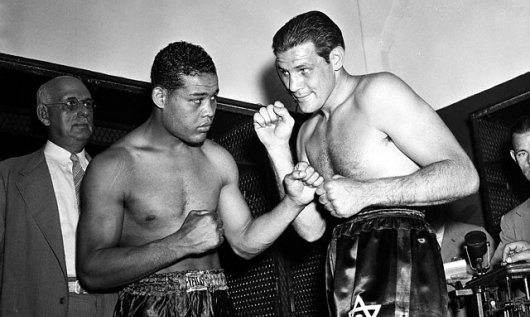
The next four rounds were a rough-and-tumble affair, with Louis holding advantages in power and accuracy while Baer, undaunted, pressed forward behind heavy right hands. To the delight of the crowd he had some success, backing Louis to the ropes in round three and pounding away, and in the fourth his attack forced Joe to hold. By this time the champion sported swelling around his left eye.
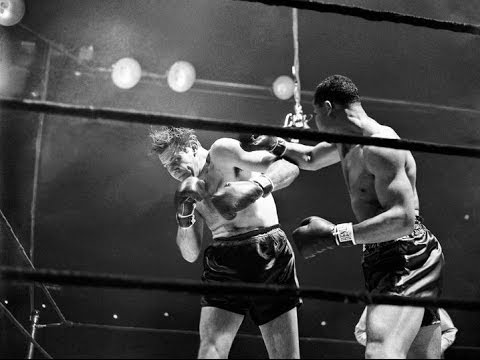
Round five saw plenty of toe-to-toe action, both men landing damaging punches, but in the sixth the champion asserted his superiority, flooring Baer twice with crushing right hands. As a dazed Buddy got to his feet from the second knockdown, the bell rang. But with all the crowd noise, Louis didn’t hear the gong and several seconds after it sounded struck Baer with another right and decked the challenger a third time.
Dragged back to his corner, Baer was clearly finished but instead of surrendering, his manager refused to let his fighter continue on the grounds he had been fouled by that after-the-bell punch. The referee disqualified Baer and the ending of an otherwise thrilling bout left a bad taste in everyone’s mouth. After Louis defeated Conn and Lou Nova, a return with Baer was set for New York’s Madison Square Garden.
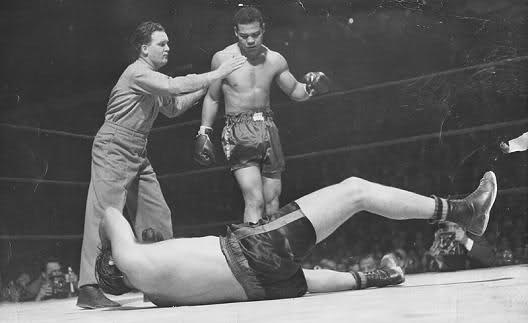
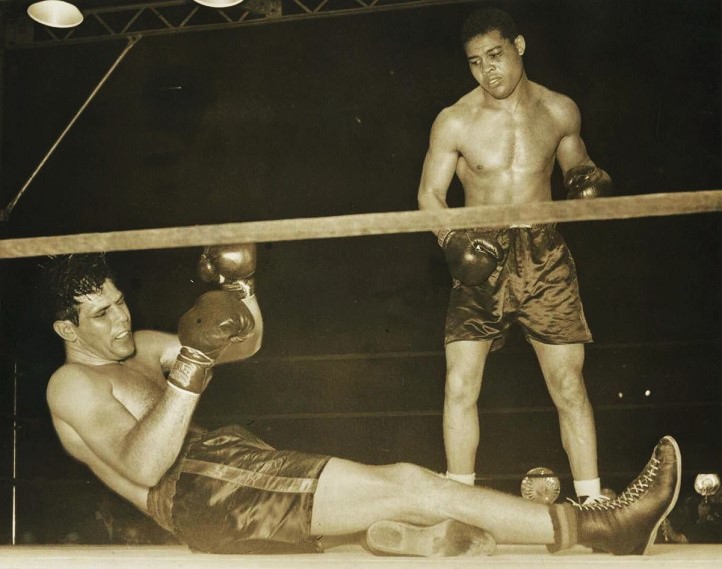
As he demonstrated a number of times, Louis was especially deadly in rematches and this time the champion attacked from the outset like a rattlesnake with sharp one-two combinations, never giving the hulking challenger a chance to get set and throw his big bombs. Just twenty seconds into the fight, the champion rocked Baer with a right before battering him from one side of the ring to the other. Two minutes in, a vicious left to the belly froze Baer and Louis struck with a snapping right to the jaw that put the much bigger man flat on his back.
The challenger rose only to be greeted by a ferocious assault which eventually sent him to the canvas a second time. Baer bravely got to his feet again, but two rights and a hard uppercut toppled him like a felled tree. This time he could not beat the count. Said Baer years later: “The only way I could have beaten Louis that night was with a baseball bat.”
This was the first in a series of matches from which Louis donated his entire purse to aid the war effort, and the next day he enlisted in the army. He was only 27-years-old, but fans would see him perform just twice over the next four years as Joe devoted himself to helping America defeat Germany and Japan, a fact which only makes his subsequent treatment by the Internal Revenue Service in the years that followed that much more cruel and ironic. When he returned from his war service, his athletic prime had passed. Thus Joe’s three minute destruction of Jacob “Buddy” Baer stands as one of the last great performances from a legendary champion who remains perhaps the most devastating puncher in heavyweight history.
Immediately after the fight Baer also joined the army and he never boxed again. He instead after the war pursued an acting career, starring in such movies as Hell Canyon Outlaws and Giant from the Unknown. – Michael Carbert
The post Jan. 9, 1942: Louis vs Baer II appeared first on The Fight City.